

If you have ever sat in a meeting and heard someone say “our ROAS is 4.2x” while everyone nodded along, this article is for you. ROAS is one of those terms that gets thrown around in digital marketing without anyone really stopping to explain it. Most of the time, the people using it do not fully understand what it means either.
I want to fix that today. ROAS is the single most important number I look at when I am running paid media for a client at Ardú Digital. If you understand it properly, you will know whether your ads are making you money or quietly draining your bank account. If you do not, you are flying blind.
In this guide, I will walk you through what ROAS actually is, how to calculate it, what a “good” number looks like in 2026, the trap most people fall into when they only look at this metric, and how to actually improve yours. By the end, you will be able to walk into your next marketing meeting and lead the conversation, not nod along to it.
What I Will Cover
Here is the agenda:
- What ROAS means and how it is calculated
- The difference between ROAS and ROI
- What a good ROAS looks like in 2026, with industry benchmarks
- How to work out your own break-even ROAS, which is the only number that really matters
- The biggest mistake I see businesses make with ROAS
- Practical ways to improve your return on ad spend
- A frequently asked questions section based on what people actually search for
Let us get into it.
What ROAS Actually Means
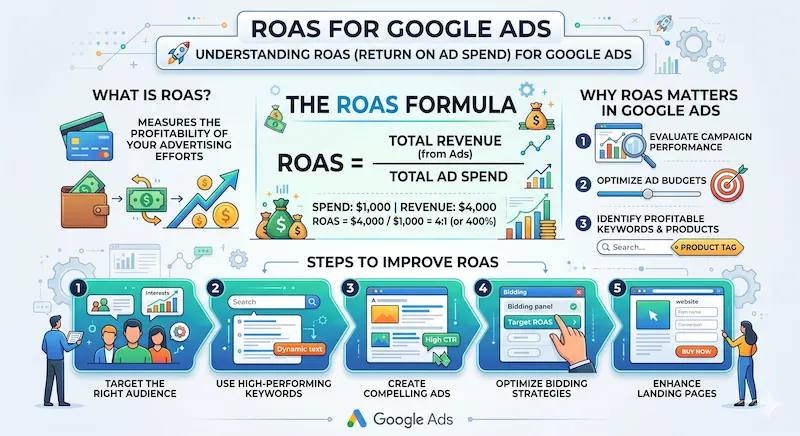
ROAS stands for Return on Ad Spend. It answers one simple question. For every euro I put into ads, how many euro did I get back in revenue?
That is it. No jargon, no complicated formulas hidden behind it. Just a ratio.
If I spend €1,000 on Google Ads and those ads generate €4,000 in revenue, my ROAS is 4. Some people write that as 4x, some write it as 4:1, some express it as 400%. They all mean the same thing. I prefer the multiple, so I will use 4x throughout this article. It is the cleanest way to read it.
Here is the formula:
ROAS = Revenue from ads ÷ Ad spend
So €4,000 ÷ €1,000 = 4x. You earned €4 for every €1 you spent.
That is the whole concept. Now let me show you why it is more useful than any other paid media metric I look at, and where it can mislead you if you are not careful.
Why I Care About ROAS More Than Almost Any Other Metric
When I take over a paid media account, the first thing I want to know is the ROAS. Not the click-through rate. Not the cost per click. Not the impression share. ROAS tells me whether the ads are doing their job, which is to make the business money.
Cost per click can be low and your ads can still be losing money. Click-through rate can be high and you can still be unprofitable. ROAS cuts through all of that. It is the only metric that ties your ad spend directly to revenue, and it is the one that tells you whether to keep going, scale up, or pull the plug.
There is one big caveat though, and I want you to remember this. ROAS measures revenue, not profit. That is a critical distinction. We are coming back to it shortly because it is where most businesses I work with go wrong.
ROAS vs ROI: They Are Not the Same
People use these terms interchangeably, but they measure different things. I want you to be clear on the difference.
ROAS only looks at the revenue you got back from your ad spend. It does not include the cost of the product you sold, your team’s salaries, shipping fees, software costs, or anything else.
ROI, or Return on Investment, includes all of those. It is the bigger picture metric. It tells you whether the campaign was actually profitable for the business as a whole.
Here is a quick example to make it stick.
You spend €1,000 on Google Ads. Those ads drive €4,000 in sales. Your ROAS is 4x.
But to deliver those sales, you spent €2,000 on the products themselves, €300 on shipping, and €200 on payment processing. So your real costs were €1,000 on ads plus €2,500 on everything else, which is €3,500 total. Your actual profit on €4,000 in revenue is €500.
The 4x ROAS looks fantastic. The €500 profit on €1,000 of ad spend tells a more sober story. Both numbers are true. They just answer different questions.
ROAS is a tactical metric for managing your ad campaigns. ROI is a strategic metric for managing your business. You need both.
What is a Good ROAS in 2026?
This is the question every client asks me first. The honest answer is “it depends,” but I am going to give you the real numbers because that answer alone is annoying.
Across all industries, the median ROAS sits at around 3.5x for Google Ads in 2026. The average is higher, closer to 5.3x, but that average is dragged up by high-margin industries like legal services. The median is the more useful benchmark.
Here are some industry-specific numbers I want you to keep in mind:
- Ecommerce on Google Ads: roughly 4.0x median, with Google Shopping campaigns hitting 3x to 5x
- Beauty and personal care: the strongest performer at around 6.1x on Google
- Legal services: often above 7x, sometimes touching 8x because of the high value of a single case
- Healthcare: much lower, around 2.1x to 2.3x
- B2B and SaaS: wildly variable, but usually 3x to 5x for direct response campaigns
- Meta Ads (Facebook and Instagram): averages 2.5x to 3x blended across industries
- TikTok Ads: averages around 1.7x, with beauty and apparel pulling that higher
A few things to note about 2026 in particular. ROAS has actually declined by about 10% year-on-year across most industries. Cost per click is up, conversion rates are slightly down, and nearly half of advertisers are reporting they missed their ROAS targets this year. That is the market we are working in. If your ROAS slipped a little this year, you are not alone, and the fix is rarely “just spend more.”
Now, here is the thing I really want you to take from this section. None of these benchmarks matter as much as one number that is specific to your business: your break-even ROAS. Let me explain.
The Number That Actually Matters: Your Break-Even ROAS
Forget the industry averages for a moment. The most important ROAS calculation you will ever do is your own break-even point. This is the number where your ads are neither making nor losing you money. Anything above it is profit. Anything below it is loss.
Here is the formula:
Break-even ROAS = 1 ÷ Gross Profit Margin
Let me give you three quick examples.
If your gross margin is 50%, your break-even ROAS is 1 ÷ 0.5 = 2x. You need at least €2 back for every €1 spent just to cover the cost of the product and the ad. Anything above 2x starts becoming profit.
If your gross margin is 30%, your break-even ROAS is 1 ÷ 0.3 = 3.33x. You need to earn €3.33 back for every €1 spent.
If your gross margin is 20%, your break-even ROAS is 1 ÷ 0.2 = 5x. That is a tough number to hit consistently, and it tells you that low-margin businesses have a much smaller window for paid media to work.
This is why a 4x ROAS is brilliant for one business and a disaster for another. A jewellery brand with 70% margins and a 4x ROAS is printing money. A grocery delivery service with 15% margins and a 4x ROAS is losing money on every order.
I want you to do this calculation today, before you do anything else. Work out your gross margin, then work out your break-even ROAS. That is the floor your campaigns need to clear. Anything below it, and you are paying customers to take your product.
The Biggest Mistake I See: Chasing ROAS at the Expense of Growth
Here is the trap. Once business owners learn what ROAS is, they fall in love with it. They start optimising for the highest possible number. And that is where they accidentally strangle their own growth.
Let me explain. The easiest way to push ROAS up is to spend less and only target your warmest, highest-intent audiences. People searching for your brand name. Past customers in remarketing lists. Repeat buyers. Those campaigns will have huge ROAS numbers. They will also stop your business growing, because you are not reaching anyone new.
A 10x ROAS on €500 of monthly spend brings in €5,000 of revenue. A 4x ROAS on €5,000 of monthly spend brings in €20,000 of revenue. Which one would you rather have?
This is the tension I work with constantly. There is a sweet spot where ROAS is high enough to be profitable, but low enough that you are still spending real money to acquire new customers. Pushing too hard for a high ROAS often means leaving growth on the table.
The way I think about it: ROAS is a brake, not an engine. It stops you from spending money on campaigns that lose money. It does not tell you how much to spend on campaigns that work. That decision is about how aggressively you want to grow.
How to Actually Improve Your ROAS
Now for the practical bit. If you have done the maths and decided your ROAS needs to come up, there are five levers I pull, in this order.
1. Fix Your Landing Page
This is almost always the biggest lever, and it is the one most businesses ignore. Lifting your landing page conversion rate from 2% to 3% increases your ROAS by 50% at zero additional ad spend. That is huge.
If your landing page has the wrong message, a slow load time, a long form, or no real social proof, your ROAS is being held back at the page, not at the ad. We have a full guide on landing pages on the Ardú Digital site that covers this in depth.
2. Tighten Your Targeting and Keywords
Negative keywords are an underused weapon. If your ads are showing for searches that will never convert (for example, “free,” “DIY,” “jobs,” “complaints”), you are paying for clicks that destroy your ROAS. A good negative keyword list pulled from your search terms report can lift ROAS noticeably within a week.
The same goes for audiences on Meta. Tight, well-defined audiences usually outperform broad ones for direct response campaigns, although broad targeting with strong creative is winning more often in 2026 than it used to.
3. Improve Your Ad Creative
In 2026, creative quality drives 50% to 70% of paid media performance, especially on Meta. The same offer, same audience, and same landing page can produce double the ROAS just on the back of better ad creative. If your ads have not been refreshed in eight weeks or more, that is usually where the leak is.
4. Raise Your Average Order Value
If you cannot get more conversions, get more revenue per conversion. Bundles, “frequently bought together” upsells, free shipping thresholds, and tiered pricing all push your average order value up. A higher average order value with the same conversion rate gives you a higher ROAS without changing your ad spend at all.
5. Get Your Tracking Right
This is the unglamorous one, but it matters. Since iOS privacy changes, Meta attribution accuracy has dropped significantly. Tools like Conversions API can recover 20% to 40% of that lost data. If your tracking is broken or partial, your reported ROAS is wrong, and any decisions you make on top of it are wrong too. Always start with the data, not the optimisation.
Putting It All Together
ROAS is the single best number you have for telling whether your paid media is working. But it is only useful if you understand what it really means and what it does not.
It measures revenue, not profit. It needs to be benchmarked against your own break-even number, not against an industry average. Chasing it too hard will quietly kill your growth. And the biggest lever to improve it is almost always your landing page, not your ad account.
If you are running paid media right now and you are not sure where your real ROAS sits (after all the costs, not just the dashboard number), that is exactly the kind of audit we run at Ardú Digital. We pull the campaign data, the margin data, and the attribution data together, and we tell you honestly whether your ads are making you money or losing you money. Get in touch and I will walk through your account with you.
Frequently Asked Questions
What is a good ROAS for Google Ads?
The median for Google Ads in 2026 sits at around 3.5x, but a “good” number for you depends on your gross margin. My rule of thumb is to calculate your break-even ROAS first (1 divided by your gross margin) and then aim for at least 1.5 to 2 times that as a target. So if your break-even is 2x, aim for 3x to 4x.
What does 4x ROAS mean?
It means you earned €4 in revenue for every €1 you spent on ads. Some people write the same number as 4:1 or 400%. They all mean the same thing.
Is ROAS the same as ROI?
No. ROAS only looks at revenue against ad spend. ROI looks at total profit against total cost, including the product, your team, software, shipping, and everything else. ROAS is great for managing campaigns. ROI is better for managing the business.
Is a higher ROAS always better?
Not always, and this surprises a lot of people. A very high ROAS often means you are only running ads to your warmest audiences and not investing in growth. I would rather see a healthy 4x ROAS on a big budget than a 10x ROAS on a tiny one, in most cases.
What is break-even ROAS and how do I calculate it?
Break-even ROAS is the minimum return you need just to cover your ad spend and the cost of the product. The formula is 1 ÷ your gross profit margin. So a 30% gross margin gives you a break-even ROAS of 3.33x. Anything below that is losing money.
Why is my ROAS dropping in 2026?
You are not alone. ROAS has declined about 10% across most industries this year. Cost per click is up, conversion rates are slightly down, and attribution has got harder since iOS privacy updates. The fix is usually some combination of better landing pages, fresher creative, tighter negative keywords, and improved tracking.
Does ROAS include VAT?
It depends how you set it up, and it is something I want you to be careful with. If your dashboard reports revenue including VAT but your ad spend is excluding VAT, your ROAS will look better than it really is. I always recommend reporting both numbers on the same basis. For Irish businesses especially, this is worth checking.
What is a good ROAS for ecommerce?
For ecommerce, a 3x to 4x ROAS on Google Ads is usually the target most stores aim for. Anything above 4x is strong. But again, your gross margin sets the floor. A store with 25% margins needs at least 4x to break even, while a store with 60% margins is profitable at 1.7x.
Can I have a high ROAS and still be losing money?
Yes, easily. If your gross margin is thin, even a “good-looking” ROAS like 3x can be unprofitable once you factor in product cost, shipping, and overhead. This is why I always start with break-even ROAS, not industry averages.
How long does it take to know if my ROAS is real?
I would not make any major decisions on less than 30 days of data, and ideally 60 to 90 days for slower-moving businesses. ROAS in the first two weeks of a new campaign is almost always misleading because the platform’s algorithm is still learning. Give it time before you judge it.
If you have read this far and you want a real, honest read on what your actual ROAS is doing right now, that is exactly what I help businesses with at Ardú Digital. We work with companies across Cork, Dublin, Galway, and the rest of Ireland to make sure their paid media is genuinely making them money, not just looking like it is. Get in touch and I will take a look at your numbers with you.